
On this page
- What do 5kW and 10kW solar system ratings mean?
- 5kW vs 10kW solar system: comparison table
- How many solar panels for 5kW or 10kW?
- Estimated daily, monthly and annual solar output
- What changes actual solar production?
- How much roof space do you need?
- Which solar system size suits your household?
- When is 5kW enough, and when is 10kW better?
- Grid-connected solar versus battery-supported solar
- Installation costs: compare quotes, not assumed price ranges
- Savings and payback: why 10kW may not save twice as much
- Can you expand a 5kW system later?
- A practical decision checklist
- Sources and estimation notes
What you need to know
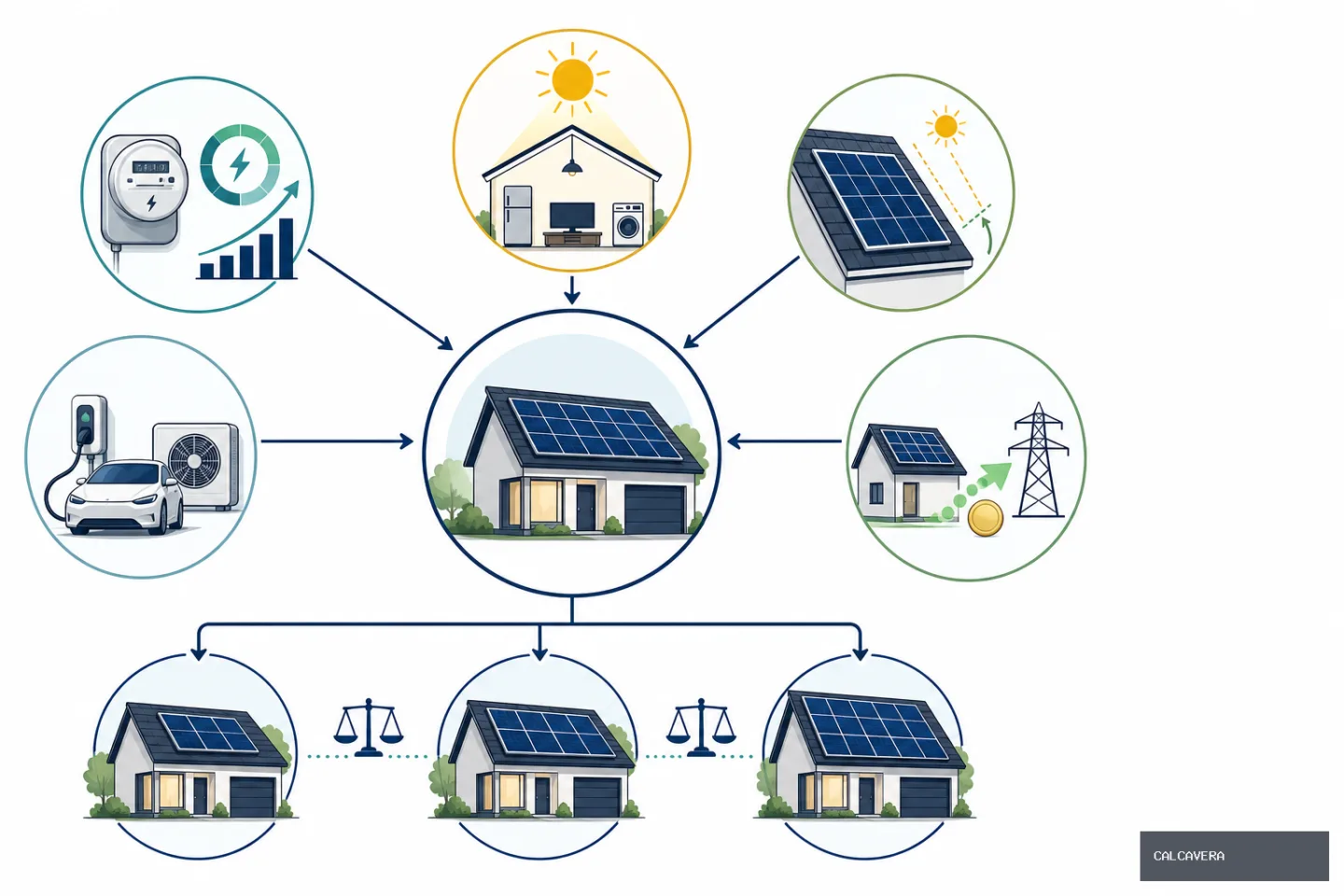
A 5kW solar system can be a sensible starting point for a home with moderate electricity use. A 10kW solar system is more likely to suit higher consumption, substantial air-conditioning demand or future electric-vehicle charging. Neither size is automatically right: local sunlight, usable roof area and the value of exported electricity can change the decision.
The key is to size solar around your electricity consumption and installation conditions, not just your home's floor area. Start with 12 months of electricity bills, then use the Calcavera Solar Panel Calculator to estimate the required solar system size.
About the figures in this guide: Production and roof-area figures below are worked examples with explicit assumptions, not location-specific forecasts. No current installation price, tariff or incentive is assumed. Use a local production model and itemized installer quotes before making a purchase.
What do 5kW and 10kW solar system ratings mean?
A kilowatt, or kW, measures power. A kilowatt-hour, or kWh, measures energy produced or consumed over time. A device drawing 1kW for two hours uses 2kWh.
In this guide, 5kW and 10kW refer to the combined DC nameplate capacity of the solar panels, rated under standard test conditions. They do not mean the system produces 5kWh or 10kWh every hour throughout the day.
Actual output rises and falls with sunlight and operating conditions. The inverter also has a separate AC power rating. An array described as 10kW may use an inverter with a different rating, so compare both panel capacity and inverter capacity in each quote.
5kW vs 10kW solar system: comparison table
| Feature | 5kW system | 10kW system |
|---|---|---|
| Nominal panel capacity | 5,000W DC | 10,000W DC |
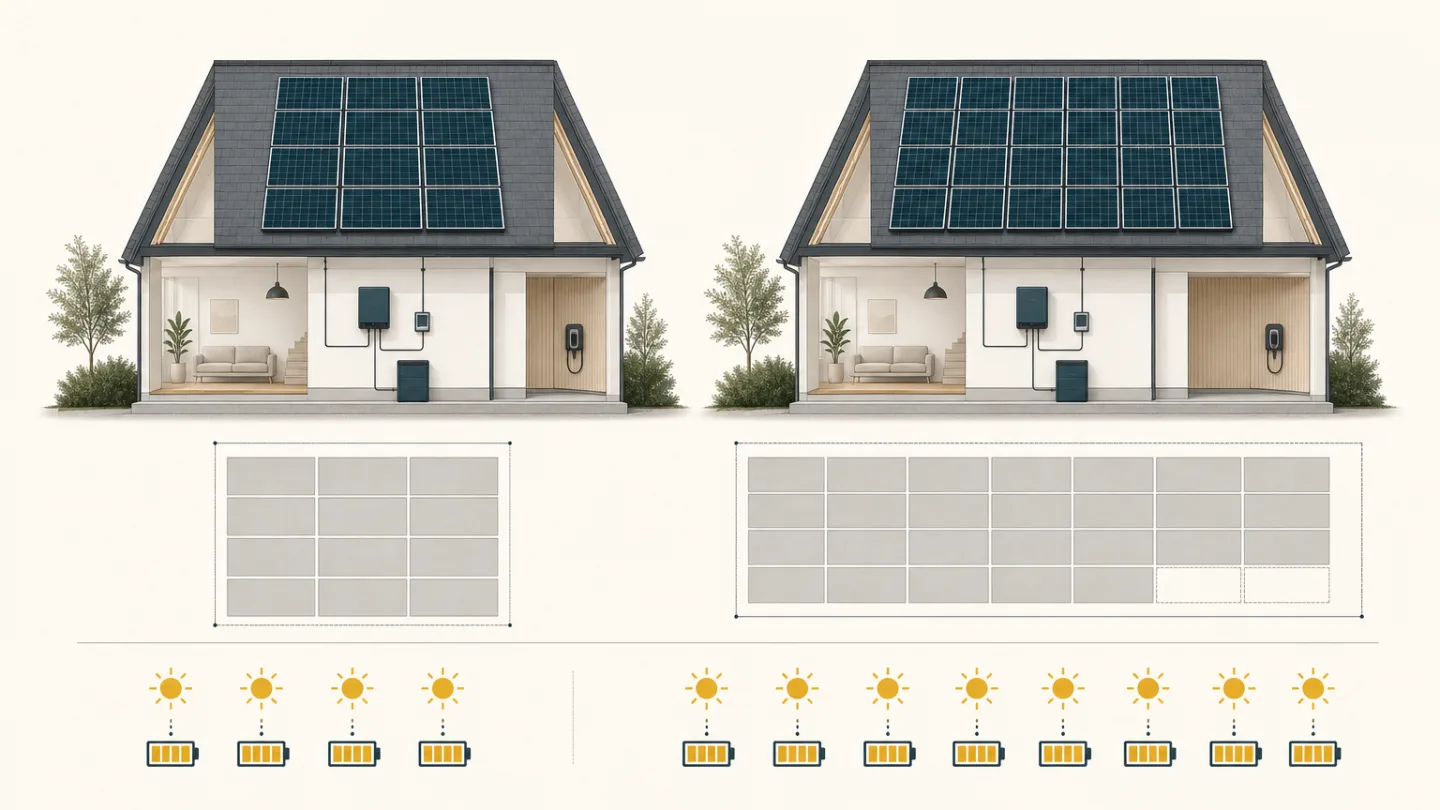
| Panels using 400W modules | 13 panels give 5.2kW | 25 panels give 10kW |
| Panels using 450W modules | 12 panels give 5.4kW | 23 panels give 10.35kW |
| Panels using 500W modules | 10 panels give 5kW | 20 panels give 10kW |
| Illustrative daily output | 16kWh | 32kWh |
| Illustrative 30-day output | 480kWh | 960kWh |
| Illustrative annual output | 5,840kWh | 11,680kWh |
| Example panel-only footprint | 25.2m² for 12 assumed 2.1m² panels | 48.3m² for 23 assumed 2.1m² panels |
| Household usage scenario to investigate | Around 15–20kWh per day | Around 30–40kWh per day |
| Likely cost relationship | Lower total upfront cost for otherwise comparable installations | Higher total cost; not necessarily twice the cost |
Table assumptions: Energy figures use exactly 5kW and 10kW, four average peak sun hours per day and an illustrative 0.80 output factor. Rounded panel configurations have slightly different capacities. Roof figures use assumed panel dimensions and exclude installation clearances. Consumption scenarios are starting points, not universal sizing rules.
How many solar panels for 5kW or 10kW?
The calculation is straightforward:
Panel count = target system capacity in watts ÷ panel wattage
For a target of at least 5kW using 450W panels:
5,000 ÷ 450 = 11.11 panels → round up to 12 panels
The resulting array is 12 × 450W = 5,400W, or 5.4kW. For at least 10kW, 10,000 ÷ 450 = 22.22, so 23 panels provide 10.35kW.
An installer might instead offer 11 panels totaling 4.95kW or 22 totaling 9.9kW. Those are close to the nominal sizes, but the actual capacity should be stated clearly.
The 400W, 450W and 500W options are calculation examples, not a claim that every locally available panel falls within that range. Check the exact module specification in your quote.
Estimated daily, monthly and annual solar output
A useful first-pass formula is:
Daily generation, kWh ≈ array capacity, kW × peak sun hours × output factor
Peak sun hours express the day's solar energy as equivalent hours at 1,000W/m². They are not the same as daylight hours. The output factor represents losses and operating effects that keep delivered electricity below a simple nameplate calculation.
For the examples below, the factor is 0.80. This is an illustrative assumption, not a universal efficiency or an NREL default.
| Assumed average peak sun hours | 5kW daily generation | 10kW daily generation |
|---|---|---|
| 3 hours | 12kWh | 24kWh |
| 4 hours | 16kWh | 32kWh |
| 5 hours | 20kWh | 40kWh |
| 6 hours | 24kWh | 48kWh |
Worked example: four average peak sun hours
- 5kW solar output: 5 × 4 × 0.80 = 16kWh per day; 16 × 30 = 480kWh over 30 days; 16 × 365 = 5,840kWh per year.
- 10kW solar output: 10 × 4 × 0.80 = 32kWh per day; 32 × 30 = 960kWh over 30 days; 32 × 365 = 11,680kWh per year.
The annual calculation assumes four peak sun hours is the annual daily average. Individual months and days will differ, sometimes considerably. The 30-day figure is a simplified example, not a prediction for every month.
For a location-specific estimate, NREL's PVWatts models grid-connected solar generation using location and system inputs. Enter the actual roof direction, tilt, array size, inverter assumptions and appropriate losses. Do not apply another blanket loss factor to an estimate that already accounts for those losses.
What changes actual solar production?
- Location and season: Local solar resources, cloud cover and seasonal day length influence output. An annual average can hide a substantial winter shortfall.
- Shading: Trees, chimneys and neighboring buildings can reduce generation. Module-level electronics do not recover sunlight that never reaches the panels.
- Roof orientation and tilt: Equator-facing roofs often favor annual production, while east- or west-facing panels can shift generation toward different parts of the day. The best financial layout depends partly on when you use electricity.
- Temperature: Higher solar-cell temperatures generally reduce power relative to the module's test rating. A hot, bright day does not necessarily deliver nameplate output.
- System losses: Wiring, inverter conversion, soiling, module mismatch and downtime can reduce delivered energy.
- Inverter and export limits: Inverter clipping or required export control can restrict usable or exported output.
A 10kW array on the same roof planes, with comparable equipment and unrestricted operation, should generate approximately twice as much as a 5kW array. That relationship can change if the extra panels occupy a shaded roof section or face a less favorable direction.
How much roof space do you need?
Calculate panel footprint from the actual module dimensions:
Panel footprint = number of panels × panel length × panel width
For illustration, assume a selected 450W module occupies 2.1m²:
- 12 panels for 5.4kW occupy 25.2m² of panel surface.
- 23 panels for 10.35kW occupy 48.3m² of panel surface.
These are not complete roof-space requirements. The installation may need additional room for spacing, access, setbacks and obstacles. Actual requirements depend on panel dimensions, roof geometry, mounting design and applicable local rules.
A large roof is not necessarily a suitable roof. Ask the installer to assess shading, condition, structural suitability and a scaled layout before choosing the larger system.
Which solar system size suits your household?
A home using around 15–20kWh per day
This corresponds to approximately 5,475–7,300kWh per year. Under the four-peak-sun-hour example, a 5kW array produces 5,840kWh annually, making it a reasonable size to investigate.
However, annual production close to annual consumption does not mean the home is self-sufficient. A household can export power at midday and buy it back at night. A 10kW system could be worthwhile if export compensation is favorable or consumption will increase, but it could also create a large low-value surplus.
A home using around 30–40kWh per day
This corresponds to approximately 10,950–14,600kWh per year. The illustrative 10kW annual output of 11,680kWh is in the same range, while the 5kW example covers a smaller share.
A 10kW array is therefore a stronger candidate, subject to local yield, roof space and export rules. At a less productive site, even 10kW may not match annual consumption.
A home with heavy air-conditioning use
Use measured consumption where possible. As a simplified example, an air conditioner averaging 2kW of electrical input for six hours uses 12kWh. Actual input varies with equipment, weather, thermostat settings and cycling.
If the rest of the home uses 18kWh per day, that example raises total use to 30kWh on cooling days. Daytime cooling can use solar directly, making additional capacity more valuable. Evening cooling depends more on grid imports or storage. Do not treat a seasonal cooling load as a year-round daily load.
A home planning to add an electric vehicle
Estimate charging energy rather than assuming every EV needs the same system size:
Vehicle energy = distance driven × energy consumption per unit of distance
For an assumed 40km daily distance and 0.18kWh/km, vehicle energy is 7.2kWh per day. Electricity drawn from the wall will be higher because charging has losses; use vehicle or charger records to refine the estimate.
If an existing home uses 18kWh per day, this example increases demand to at least 25.2kWh before charging losses. That can justify examining a larger array. Daytime home charging improves direct solar use; overnight charging makes tariff design and storage more important.
When is 5kW enough, and when is 10kW better?
Investigate 5kW first when:
- Your annual use is moderate and local modeled production covers a useful share of it.
- Your budget or unshaded roof area is limited.
- You have little daytime demand and exported electricity has low value.
- You do not expect a major increase in electricity use.
Investigate 10kW first when:
- You already use around 30–40kWh per day, or a local model supports a similar capacity.
- You have significant daytime cooling, heating or other electrical loads.
- You plan to add EV charging or replace fuel-powered equipment with electric alternatives.
- You have enough suitable roof space and a viable grid connection.
- The additional generation has demonstrable value through self-consumption, exports or storage.
These are not the only choices. A system between 5kW and 10kW may better match your demand, roof and budget.
Grid-connected solar versus battery-supported solar
A grid-connected system without a battery supplies household loads while generating. Any permitted surplus goes to the grid, and the home imports electricity when solar production is insufficient.
A battery can store some surplus for later use. Its usefulness depends on the amount of available surplus, evening demand, usable capacity, charge and discharge power, and tariff arrangements.
Solar capacity is measured in kW; battery energy capacity is measured in kWh. A 10kW solar array does not automatically need a 10kWh battery, and a smaller array may not reliably fill a large battery during low-production months.
Storage introduces losses and extra costs, so it should be assessed separately. Backup capability is also a separate design question: ordinary grid-connected solar generally shuts down during a grid outage. A battery only provides backup when the system includes compatible equipment and is configured for that purpose.
Installation costs: compare quotes, not assumed price ranges
There is no single trustworthy global price for either size. Location, currency, labor, equipment, roof access and local incentives all affect the final amount. Without current local evidence, a numerical price range would be misleading.
For otherwise comparable projects, 10kW normally costs more in total than 5kW. It does not necessarily cost twice as much, because some design, access and electrical-work costs are shared across either installation.
Compare itemized quotes covering:
- Exact panel capacity and inverter AC rating.
- Panel, inverter and mounting equipment.
- Roof access, mounting complexity and any roof repairs.
- Electrical-panel work, metering and grid-connection requirements.
- Shading-related equipment and monitoring.
- Battery equipment and backup work, if included.
- Taxes, incentives and what the quoted net price assumes.
Installed cost per watt = comparable installed cost ÷ actual DC array watts. Use consistent scope and currency. A lower cost per watt does not guarantee a better financial result if much of the extra generation has little value.
Savings and payback: why 10kW may not save twice as much
The value of solar depends on where each kWh goes:
Annual energy value ≈ self-consumed kWh × avoided import rate + exported kWh × export payment rate
This simplified formula assumes flat rates. Time-of-use prices, net-metering arrangements, export caps, taxes and other billing rules may require a more detailed calculation. Fixed bill charges may remain.
Worked example without invented tariffs
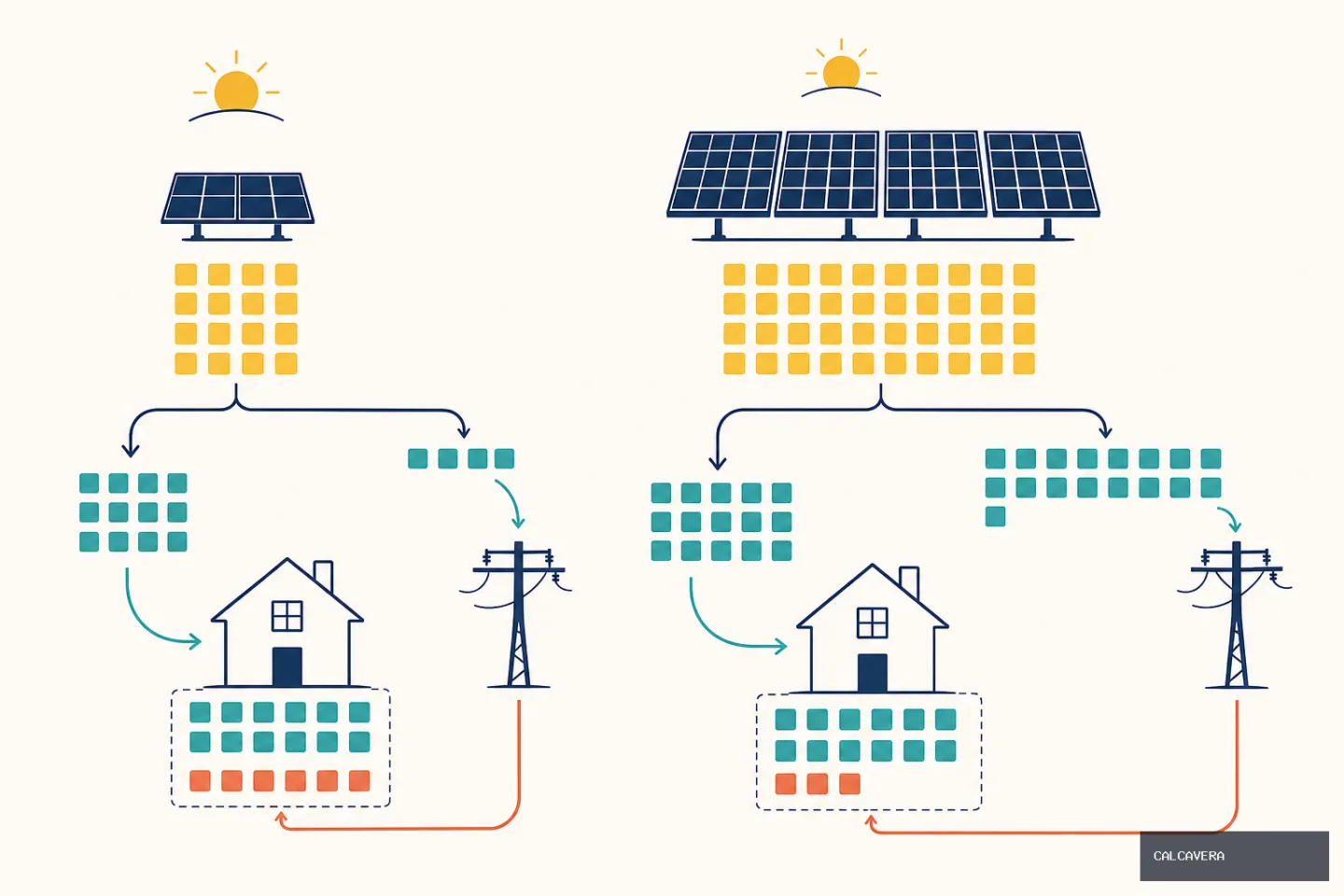
Consider a household using 18kWh per day. Assume no battery, no curtailment and these simplified average energy flows:
| Daily energy flow | 5kW example | 10kW example |
|---|---|---|
| Solar generation | 16kWh | 32kWh |
| Solar used directly in the home | 12kWh | 15kWh |
| Solar exported | 4kWh | 17kWh |
| Electricity imported | 6kWh | 3kWh |
Let R be the applicable avoided import price per kWh and E the export payment per kWh, in your currency:
- 5kW annual energy value: 4,380R + 1,460E.
- 10kW annual energy value: 5,475R + 6,205E.
- Additional annual value from 10kW: 1,095R + 4,745E.
Generation doubles in this example, but direct use increases by only 3kWh per day. Most additional electricity is exported. If E is much lower than R, financial savings increase by much less than twofold. These energy flows are illustrative, not predictions for every household.
Simple payback = net upfront cost ÷ estimated annual net savings. Annual net savings should account for relevant ongoing costs. For the upgrade decision, compare the additional installed cost of 10kW with its additional annual net benefit.
Simple payback omits financing, the time value of money, changes in electricity prices, equipment replacement and changing output. Treat it as one comparison tool, not a guaranteed investment return.
Can you expand a 5kW system later?
Expansion can be possible, but it is not always a simple panel addition. Discuss it before signing the initial contract.
- Reserve suitable roof space, not just any remaining roof area.
- Check inverter input limits, string design and electrical capacity.
- Ask whether expansion needs a second inverter or replacement equipment.
- Confirm grid approval and any effect on export arrangements or incentives.
- Check compatibility if the original panel model becomes unavailable.
- Compare the total staged-installation cost with installing the larger system now.
An oversized inverter alone does not guarantee an easy upgrade. Request a written technical plan for the proposed future capacity.
A practical decision checklist
- Measure demand: Collect 12 months of kWh usage and identify seasonal peaks.
- Check timing: Use interval-meter data where available to distinguish daytime use from evening and overnight use.
- Add future loads: Estimate EV charging, cooling, heating and other planned changes.
- Estimate capacity: For a first pass, divide target daily generation by peak sun hours × output factor.
- Model the actual roof: Compare 5kW, 10kW and an intermediate size using location-specific production estimates.
- Check constraints: Confirm roof suitability, inverter design, grid approval and export limits.
- Compare incremental value: Ask what the extra capacity costs and how much additional electricity you will use or sell.
For example, targeting 18kWh per day with four peak sun hours and a 0.80 factor gives 18 ÷ (4 × 0.80) = 5.625kW. Targeting 35kWh gives 10.94kW. These estimate capacity for an average energy target; they do not guarantee independence from the grid.
Bottom line: Choose the system whose modeled generation, usable roof area and incremental financial value fit your household. A well-matched 5kW system can be better than an underused 10kW system, while a high-consumption home may benefit from the larger array.
Sources and estimation notes
- NREL PVWatts Calculator: https://pvwatts.nrel.gov/ — authoritative location-based modeling tool for grid-connected photovoltaic energy production. The production tables in this guide are transparent arithmetic examples, not PVWatts results.
- U.S. Department of Energy, Planning a Home Solar Electric System: https://www.energy.gov/energysaver/planning-home-solar-electric-system — guidance on electricity needs, solar-resource assessment, system options and installation planning.
- U.S. Department of Energy, Homeowner's Guide to Going Solar: https://www.energy.gov/eere/solar/homeowners-guide-going-solar — guidance on rooftop suitability, costs, financing and homeowner considerations.
These resources support the technical approach, not an unverified local price or savings promise. For current prices, incentives, export terms and connection requirements, obtain local written information and verify it with the relevant utility or government agency.
Frequently asked questions
How many solar panels do I need for a 5kW system?
Divide 5,000 watts by the wattage of each panel. With 400W panels, 13 panels provide 5.2kW; with 450W panels, 12 provide 5.4kW; with 500W panels, 10 provide exactly 5kW. Installers may propose a slightly smaller or larger array to suit the roof, inverter and available panels.
How many solar panels do I need for a 10kW system?
With 400W panels, 25 panels provide exactly 10kW. With 450W panels, 23 provide 10.35kW, while 20 panels rated at 500W provide exactly 10kW. Check both panel wattage and physical dimensions when comparing quotes.
How much electricity does a 5kW solar system produce per day?
As an illustrative calculation, 5kW × 4 peak sun hours × 0.80 gives 16kWh per day. This is an average estimate under stated assumptions, not a guaranteed daily output. Location, season, shading, roof direction, temperature and equipment losses can change the result substantially.
Is a 5kW solar system enough for a home using 20kWh per day?
It may cover a substantial share of annual electricity use, but it will not necessarily cover all of it. Under the guide's four-peak-sun-hour example, it produces about 16kWh per day on average. A sunnier site could produce more, while a shaded or less sunny site could produce less. Electricity used after sunset still requires the grid or stored energy.
Is a 10kW solar system too big for a small household?
It can be oversized financially if the home uses little electricity during solar hours and receives a low export payment. It may still make sense with favorable export rules, substantial future demand or a suitable battery. Compare the value of the additional generation rather than assuming the larger system is better.
Will a 10kW system save twice as much money as a 5kW system?
Not automatically. Similar installations may generate approximately twice as much electricity, but the additional energy might mostly be exported at a lower value than the retail electricity rate. Export limits, time-of-use pricing, battery losses and fixed bill charges also affect savings.
Do I need a battery with a 5kW or 10kW solar system?
No. Either size can operate as a grid-connected system without a battery. Storage can move some daytime generation into the evening, but it adds cost and losses. Backup power requires compatible equipment and an appropriate backup configuration; ordinary grid-connected solar generally does not power a home during an outage.
Can I install 5kW now and expand to 10kW later?
Possibly, but expansion should be planned before installation. Roof space, inverter capacity, electrical equipment, grid approval, panel compatibility and export rules can all constrain an upgrade. Ask for a written expansion plan and compare its total cost with installing the larger system initially.